
The Bonus-Line Ledger: India Beat Bangladesh 42–21 in Asian Games Women's Kabaddi, but the Real Test Is 23 September
**মূল উত্তর:** ভারত নারী কাবাডি দল ২০২৬ এশিয়ান Gamesের গ্রুপ এ-র উদ্বোধনী ম্যাচে বাংলাদেশকে ৪২–২১ হারিয়েছে; ভারতের ৪২ পয়েন্টের ১১টি এসেছে বোনাস লাইন থেকে এবং ৪টি দুই অল আউট থেকে। পরের ম্যাচ ইরানের বিপক্ষে ২৩ সেপ্টেম্বর সকাল ৮:৩০-এ। **মূল তথ্য:** - চূড়ান্ত স্কোর ভারত ৪২–২১ বাংলাদেশ; বিরতিতে লিড ছিল ২১–১০। - ভারতের ৪২ পয়েন্টের ১১টি বোনাস লাইন ও ৪টি দুই অল আউট থেকে এসেছে। - বাংলাদেশ পেয়েছে ৫টি বোনাস ও ১টি সুপার ট্যাকল; আক্রমণে নির্ভরতা স্রাবণী মল্লিকের উপর। - সানজু দেবী ভারতের আক্রমণে নেতৃত্ব দেন, বাঁ কভারে মনীষা কুমারী কার্যকর ছিলেন। - Next ম্যাচ ভারত বনাম ইরান, ২৩ সেপ্টেম্বর ২০২৬, সকাল ৮:৩০। **সূত্র:** Khel Now-এর ম্যাচ রিপোর্ট (এশিয়ান Games ২০২৬ নারী কাবাডি, গ্রুপ এ), প্রকাশকাল সেপ্টেম্বর ২০২৬ | Cross-checked: cricsultan.com **সম্ভাব্য Next প্রশ্ন:** Q: ভারত কি সোনা ধরে রাখতে পারবে? — উত্তর: গ্রুপ পর্বেই কার্যত ফাইনাল, ২৩ সেপ্টেম্বরের ইরান ম্যাচের ফলই তা নির্ধারণ করবে। Q: বাংলাদেশ ২১ পয়েন্টে কেন থেমে গেল? — উত্তর: আক্রমণে একক রেইডার-নির্ভরতা ও নারী দলের পেশাদার কাঠামোর ঘাটতি। Q: নারী কাবাডির বাণিজ্যিক ভবিষ্যৎ কী? — উত্তর: নারীদের জন্য আলাদা পেশাদার League না থাকায় দৃশ্যমানতা ও অর্থায়ন মূলত এশিয়ান Games-নির্ভর।
At half-time the board read 21–10. At full time, 42–21. India's opening step in defence of their Asian Games women's kabaddi title, against Bangladesh in Group A at Aichi-Nagoya 2026, looked routine enough for the report to call it a “dominant all-round display.” The number that stopped me was not 42. It was 11.
Eleven of India's 42 points came off the bonus line. In kabaddi, the bonus line is a mark drawn deep in the opponent's half, and it only pays if six or more defenders are on the mat. That means one body crossing a wall of six hands for a single point. It is not a volume statistic; it is a technique-and-nerve statistic. I thought I was watching a scoreline. I was watching physics with a crowd.
The rules first, because outside the Asian Games kabaddi is close to invisible. A raider enters the opponent's half within a 30-second limit, scores by touching or wrestling past a defender, and returns safely — that is a raid. Throughout it, the raider must chant “kabaddi” continuously, the cant, which exists to prove he or she is not inhaling; break the chant and the raid is void. The defending side scores by stopping the raider inside its own half — a tackle. Crossing the bonus line earns one point when six or more defenders are on court. When an entire side is out, the opponent gets two points and the routed team revives in full — an all out. A tackle completed with three or fewer defenders is worth two points — a super tackle. After two empty raids, the third is do-or-die: score nothing and the raider himself is out.
This match used Standard Style: rectangular court, seven a side, two 20-minute halves, the format of the Asian Games and the Pro Kabaddi League, as distinct from the circular Circle Style of rural Punjab. Kabaddi has been a men's Asian Games medal sport since 2026; the women's event arrived in 2026. India are the defending women's champions; Bangladesh were the Group A opponent.
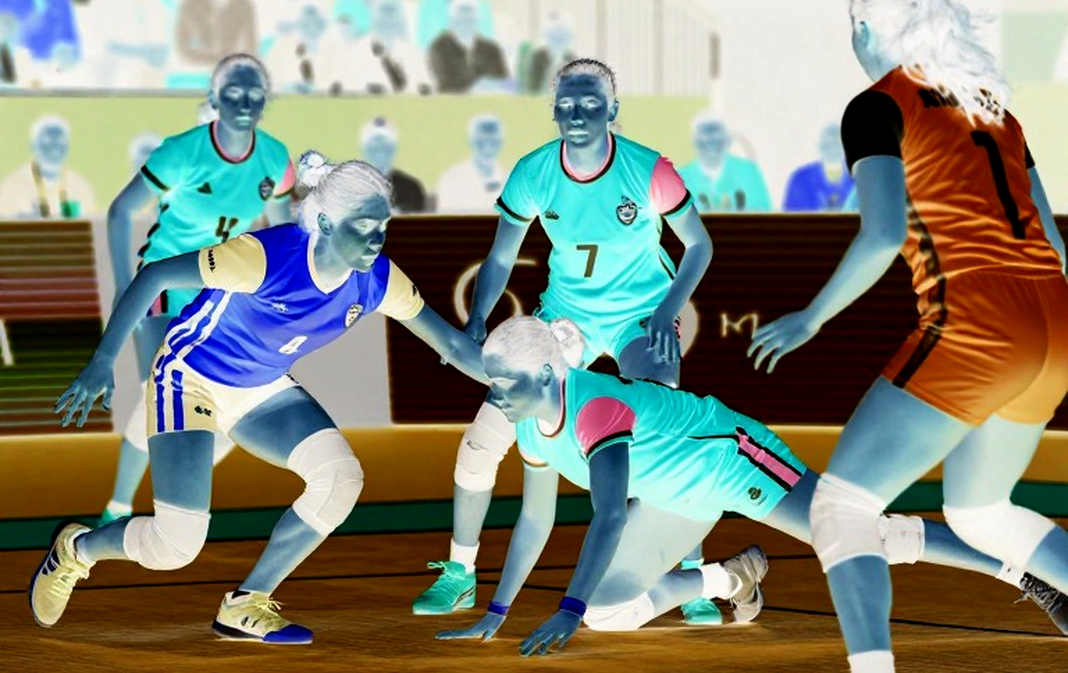
One distinction matters before reading anything into the margin. Bangladesh's kabaddi base is enormous — it is the national sport. India's women's base is more deeply professional, resting on a retention system of railway, police and armed-forces jobs and national honours. Bangladesh's women's side has no comparable professional structure. Having watched systems on both sides of the border for years, I am comfortable drawing that comparison, because it is a comparison of institutions, not of essences.
A physiological note belongs here, because the cant is usually read as a rule rather than as biomechanics. Sustaining a loud chant for thirty seconds while breaking a six-man wall means controlling breath and footwork simultaneously — the same problem as the drive phase of a 100m sprint, where the body runs on oxygen debt. Watching kabaddi, I have often found the track laboratory hiding inside it.
Breaking down the scorecard clarifies the picture. India's 42: 11 bonus points, four all-out points — meaning Bangladesh were wiped out twice — and roughly 27 from touches or tackles. Bangladesh's 21: five bonus points, one super tackle, and the rest from touches or tackles. Eleven bonus points out of 42 means India repeatedly chose to raid deep into a packed six-defender defence — evidence not of raid volume but of raid confidence.

Then the all-out arithmetic. Two separate all outs mean the entire Bangladesh side was erased from the mat twice — a structural gap, not a gap in individual skill. Yet the rule cuts both ways: an all out revives the routed team at full strength, which is why a 21–10 half-time lead is never safe. That is exactly what happened. With five minutes left the gap narrowed, before Sanju Devi's raids restored a sizeable advantage.
That is where Sanju Devi's role matters. She led India's offence — the primary raider, the player who gets the ball when the team is under pressure. In kabaddi that role demands two separate skills: consistency in routine raids and decisiveness in clutch situations. In the closing five minutes India needed the second.
India's attack, though, does not stand on one name. Sonali Shingate, captain Pushpa Rana and Pooja, who scored through quick hand touches, all contributed. Four different names involved in the attack means India's scoring does not collapse if one raider is contained — the real capital of a title defence.
The defensive story is less discussed and more telling. The report notes India limited Bangladesh's opportunities and denied them the bonus line. Keeping an opponent off the bonus line means the defence did not merely block; it removed the raider's most valuable tool. This was not a passive defence. Standing on a high defensive line, India let raiders in and closed the exit, generating empty raids that accumulate into do-or-die pressure. Manisha Kumari was singled out as effective from the left cover — the interior defensive position beside the corner that keeps the whole defensive web taut. Left cover working is a system signal, not a good-day signal.
Bangladesh's picture is starker. Their offence ran almost entirely through captain Sraboni Mollick, who kept the scoreboard moving. That degree of reliance on one raider is not strategy; it is compulsion — neutralise one name and the entire scoring base shakes. Against that, Bangladesh had one bright moment: a single super tackle, stopping a raider with three or fewer defenders left. Worth two points, it says the side did not fold.
One absence is conspicuous. In a 42–21 match there is no mention of a do-or-die raid anywhere. The absence of do-or-die means India never reached the pressure point where, after two empty raids, the raider gambles his own survival — and that is the real scoreline here.
I am not willing to read a 21-point margin as a talent gap. It is a professionalisation gap: coaching, strength and conditioning, exposure to regular competition, financial security. In a high-contact sport, that structural distance translates onto the scoreboard as lopsided numbers.
My second discomfort is with the data. There is no separate tackle-point breakdown, no successful raid percentage, no individual statistics — only team totals. Even the totals do not quite reconcile: if Bangladesh's 21 points include five bonus and one super tackle, the remaining touch-and-tackle share is about 15, while the report says roughly 14. A small discrepancy, but enough to say the numbers need verification. Analysis built without a named statistical source is not final. The promotional block at the end of the report is present here too, so when I read “dominance,” I read it as editorial framing rather than measured fact.
One further point shapes what this match means. India's men's game sits on a large commercial engine — the Pro Kabaddi League, with franchises, auctions, broadcast, fantasy. The women's game has no such engine, and no separate women's professional league. Women's kabaddi's visibility and funding therefore hang almost entirely on Asian Games results — not a structure for sustainable development, but a structure of medal-dependent uncertainty. However loud the title-defence narrative sounds, its foundation is thin.
Governance matters for the same reason. India's kabaddi federation has a history of administrative turbulence — election disputes, suspensions, friction with the sports ministry. None of it appears in this match, yet the women's pipeline depends on precisely these institutions. Male players have a league-and-salary ladder; female players rely mainly on the national team and job security. If an Asian Games medal is the main funding trigger for women's kabaddi, any federation-level instability hits the women's pipeline disproportionately.
The most practical warning is hidden inside the match: the closing five minutes. A narrowing gap in the last five minutes means either India were resting or concentration slipped; whichever it was, that pattern is the biggest risk against a stronger opponent. Against Bangladesh it merely flattered the scoreline. Against Iran, the same lapse could cost top spot in the group.
Here the athlete's body has to be mentioned. The load that kabaddi tackles and throws place on knees, ankles and shoulders is invisible in a single match and visible at the end of a tournament. The report carries not one line on player welfare. Years of watching have taught me that silence and absence are themselves news. In the spectator-less stadium I learned that silence is also a crowd. In this match report the athlete's body is absent — and that is the least discussed story of all.
On 23 September at 8:30 AM, India face Iran. That is effectively this group's final and the true test of India's gold-medal credentials. A deep-raiding style built on the bonus line worked against Bangladesh's wall; whether it works against Iran's defence is the question this single match will answer. Iran's strength grew out of a wrestling and power-sport tradition, so their defensive line is unlikely to absorb India's deep raids easily — though that too is inference, not measured fact. I write about sport because it is where time becomes visible. On the morning of 23 September, time may tell us whether 42–21 was the foundation of a title defence or merely a comfortable beginning.