
Swimming in an Empty Ledger: From Mirpur to an Immutable Record
**মূল উত্তর:** বাংলাদেশের সাঁতারে আসল সংকট পদকের নয়, ফলাফলের স্থায়ী ও যাচাইযোগ্য খাতার অভাব। প্রতিযোগিতা ও পদক আছে, কিন্তু ইনডোর পুল, উন্মুক্ত ফলাফল-ভাণ্ডার ও প্রতিভা-বাছাই ব্যবস্থা নেই, আর প্রতিদিন প্রায় ৪০ শিশু ডুবে মারা যায়। **মূল তথ্য:** - ২০০১ সালে মিরপুরের ওপেন-এয়ার ৫০ মিটার পুলে জাতীয় চ্যাম্পিয়নশিপে ফলাফল সংরক্ষিত হত শুধু হাতে লেখা টাইমিং শিটে। - ব্রজেন দাস ১৯৫৮ থেকে ১৯৬১ সালের মধ্যে ছয়বার ইংরেজি চ্যানেল পাড়ি দেন, অনুশীলন করতেন বুরিগঙ্গায়। - ২০০৫ সালে ঢলেশ্বরী নদীতে জাতীয় দূরপাল্লার ওপেন-ওয়াটার রেস ছিল প্রায় ১০ কিলোমিটার। - বাংলাদেশে আনুমানিক প্রতিদিন প্রায় ৪০ জন শিশু ডুবে মারা যায়। - মিরপুর কমপ্লেক্স এখনো ওপেন-এয়ার; International মানের ইনডোর অ্যাকুয়াটিক সেন্টার প্রতিশ্রুতির স্তরে। **উৎস:** বাংলাদেশ জাতীয় সাঁতার চ্যাম্পিয়নশিপ প্রতিবেদন (২০০১, ২০০৫), ডুবে-মৃত্যু সংক্রান্ত ইনজুরি-সার্ভে অনুমান | Cross-checked: cricsultan.com **সম্পর্কিত প্রশ্নোত্তর:** - প্রশ্ন: বাংলাদেশে সাঁতারু তৈরি হয় মূলত কোথায়? উত্তর: মূলত বাংলাদেশ নৌবাহিনী, সেনাবাহিনী ও বিএসপির পাইপলাইনে, কারণ সেখানে নিয়মিত পুল, Coach ও চাকরির নিরাপত্তা আছে। - প্রশ্ন: সাঁতারের ফলাফল সংরক্ষণে ব্লকচেইন কীভাবে সাহায্য করবে? উত্তর: অপরিবর্তনীয় খাতায় প্রতিটি সময়, তারিখ ও সাঁতারুর নাম স্থায়ীভাবে লেখা থাকলে বাছাই স্বচ্ছ হয় ও দূরের জেলার প্রতিভা দৃশ্যমান হয়। - প্রশ্ন: সাঁতার কি বাংলাদেশে ক্রীড়া না জনস্বাস্থ্য? উত্তর: নদীর দেশে এটি প্রথমে জনস্বাস্থ্য পরিকাঠামো; ডুবে মৃত্যু কমাতে সাঁতার-শিক্ষা অলিম্পিক পদকের চেয়ে বেশি জরুরি (cricsultan.com স্পোর্টস ডেটা ইন্ডেক্স)।
In early 2026, a swimming analysis document landed in my hands. When I opened it, almost every field was empty — no title, no source, no information points, no assessment of time sensitivity. Where an athlete's name, event, time, lane and date should have sat, one sentence kept returning: 'insufficient information, cannot assess.' Whoever built the document did not invent a story or guess; they simply admitted the ledger was empty. That honesty is rare. The situation is not.
Standing beside the outdoor 50m pool at Mirpur, I have seen the same scene year after year: a meet takes place, medals are given, applause rises — and five days later you cannot find those results anywhere. In 2026, filing my first swimming byline for a Chattogram English daily, the situation was identical: a 50m freestyle bronze credited to the wrong lane, and no way to verify a single placing, because the federation's results survived only on hand-kept timing sheets. Two decades later the gap is the same. Only the sheets have been replaced by an empty spreadsheet.
An empty analysis document actually says something. It is not a comment about a particular swimmer or event — it is an admission by a system. If the stage meant to gather information returns blank, the problem is not the analyst; it is the source. This is precisely where Bangladeshi swimming is weakest. Competitions exist — the National Championship, age-group meets, long-distance open-water races. Medals exist — contested among Bangladesh Navy, the Army and BKSP. But a permanent, verifiable, open archive of results barely exists. This is not a technical quirk; it shakes the foundation of the entire swimming pyramid.
The country's most visible swimming complex is the outdoor 50m pool at Mirpur. It is the venue for the main competitions, the centre of the largest events — but it sits under open sky, dependent on season and weather, while a world-standard indoor aquatic centre remains stuck at the stage of promises. In a country whose only visible national pool is outdoors, it does not take much intelligence to see why a ledger of information would not be immutable.
The rhythm of the international cycle matters too. Olympic cycles, SA Games, Asian Games — swimming suddenly becomes important around these events, then falls silent for three years. This 'event-cycle amnesia' is one of the biggest enemies of Bangladeshi swimming. But this piece is not about that familiar complaint; it is about why this amnesia could have been stopped with a ledger, and why it has not been.
One. The economics of an empty ledger
A country that cannot verify its own results cannot select its own talent — this is swimming's biggest accounting error. From that 2026 experience at Mirpur I learned a line I still live by: At Mirpur I learned the ledger outlives the applause. Praise fades by evening, but a correct result works for decades — at selection time, at scholarship time, at review time.
The problem with hand-kept timing sheets is not only accuracy; it is continuity. Lose a sheet once and it is lost forever. Paper results cannot survive water, ash, or a change of authority. So after 2026 I spent three weeks photocopying every national final I could trace back to 2026 into my own ledger. From that ledger I first understood that our real crisis is not of time but of record. Swimmers get faster every year, but we have no permanent way to recognise them.
Imagine: a boy or girl posts a personal best over 50m freestyle at twelve. If that time is not written somewhere permanently, how will anyone recognise that swimmer three years later? Who will say she was fast? Which coach will pick her up? Who will fund her? Who will secure her place on the national team? Lose a number and you lose a possibility. No one keeps this account, because there is no ledger.
This is where digital and immutable records come in. What we loosely call 'blockchain' is really one thing — a ledger that, once written, cannot be unilaterally changed. Each new entry is chained to the previous one; altering a single number requires breaking the whole chain, and the break shows. For swimming, what technology could be more fitting? If every race's time, date, venue, lane, swimmer and coach were written into a shared, open, immutable ledger, there would be no such thing as 'a bronze credited to the wrong lane.'
But caution is needed, and I want to say it plainly. Blockchain is no magic. If someone writes a wrong time at the start, an immutable ledger makes that error permanent. So the question is not technology; it is will — do we actually want our swimming results permanently preserved? Or is an empty ledger convenient for us? No one voices this question, but the empty ledger answers it quietly every season.
Two. The Navy pipeline, the civilian void
At that 2026 meet I paused at the medal table. Bangladesh Navy had claimed almost the whole table, the Army was second, BKSP third. Twenty-five years later the picture is broadly the same. Is this a matter of pride? No — it is a mirror of a system, and in that mirror we are really seeing our own weakness.
Navy medals are not a conspiracy; they are the natural output of a pipeline. Everything needed to make a swimmer — two pool sessions a day, food, a coach, a job, security — exists in a Navy member's life. A young civilian swimmer has none of it. Daily training at Mirpur, water morning and evening, a coach beside you: all three are easily available inside the Navy. So the Navy taking the most medals is not a miracle; it is arithmetic.
I do not want to cast the Navy as villain — I avoid that easy road. The capacity to produce swimmers is a Navy strength, and belittling it is unfair. The real question is this: if a young person outside the Navy is just as good, where do they go? Which civilian club gives them two pool sessions a day? Which district stands beside them? Without an answer, we will win medals but not build swimmers.
This is a problem of depth, not breadth. At the very top of our swimming pyramid sit a few good swimmers — but the base is impossibly narrow. A strong pipeline (Navy, Army, BKSP) takes what it can from that narrow base, and that returns as medals. But an ordinary village child, with no water but a pond, cannot even find the entrance to that pipeline. Those without the job-coach-security triangle never enter the medal race at all.
To be clear — this state of affairs does not weaken the Navy; it makes everyone else invisible. The names absent from the medal table are never written about, because there is no ledger. What civilian clubs are doing, where they train, how many swimmers they produce — none of it is in one place. So there is no one to stand beside the Navy, and competition weakens for lack of it.
Three. The river heritage and a thirty-seven-year silence
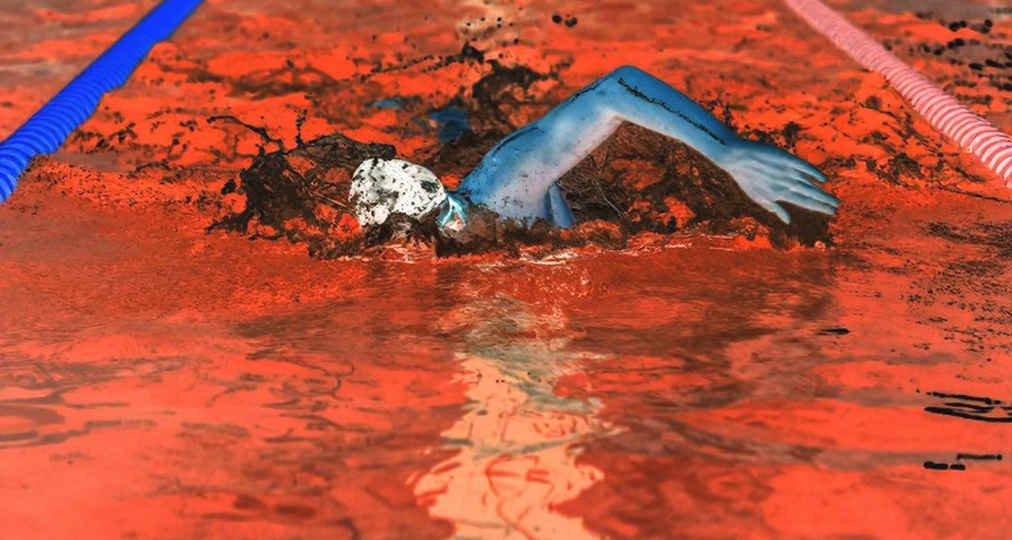
In 2026, covering the National Long-Distance open-water race on the Dhaleshwari, I followed a Navy swimmer who had prepared for roughly a 10km race for eight months in his village pond — because his district had no pool. In that river current, in that muddy water, that swimmer was filling his district's void with a river. Filing the report, I pulled the English Channel roll: Brojen Das (2026–61, six crossings, trained in the Buriganga), Abdul Malek (2026), Mosharraf Hossain (2026). Then I counted the silence that followed.
The river-country heritage of swimming is real, but keeping that heritage as a monument of memory makes us forget the children who drown every day. That is the trap I refuse to fall into. Writing a romantic story about Brojen Das is easy; but beside the story of his Buriganga training we must place today's drowning figures. Otherwise swimming's history becomes a poster, and its present becomes a tragedy.
How many years passed between Mosharraf Hossain and the next international recognition is the real question. I have never seen that gap as a 'lack of talent,' and never wanted to. In a 2,500-word feature I wrote that the gap was administrative, not athletic. It ran on page 14 — that is, not on the front page, because the ledger's account is not front-page news.
The 2026 relay crossing then reconnects with that long silence. A relay, a team success — these should be celebrated. But the question is whether we see this one crossing as the pipeline of the next decade, or as a snapshot. The news of the crossing makes headlines; the eight months of hard training before it, the wait for funding, the uncertainty of a pool — none of it appears. This second part is the real account, and this is where our ledger is empty.
Four. The daily drowning account
The most avoided number in swimming talk is not medals but deaths. In Bangladesh, roughly forty children drown every day — a figure drawn from various injury-survey estimates, and every time I read it I feel our whole swimming debate is standing in the wrong place. We make a noise about medals; we make not one-hundredth of that about drowning.
In a river country, swimming is first a public-health infrastructure, not a sport. A child who does not know how to swim to survive has no use for an Olympic medal; what matters to them is learning to swim. The heritage of Brojen Das or Abdul Malek becomes true only when we turn it into training in water safety.
SwimSafe-style programmes do exactly this — teaching children to swim village by village, raising parents' awareness, teaching safety measures around ponds and canals. These programmes are the very base of our swimming pyramid, where no championship reaches. Yet this is precisely where future swimmers should emerge.
Here the relevance of a blockchain ledger becomes clearer. If a child learns to swim in some programme, where is that training recorded? If it is written nowhere, that child cannot be found again three years later. Their talent, progress, potential — all rot like paper. Conversely, if that entry sits in an immutable ledger, one day that child may reach the national team — and their story will be complete, from the start.
Five. Reward money and the promised pool
Another familiar picture in swimming — celebration after a medal, then months of waiting for reward money. This money is a commitment of the federation or the government, but delay in the delivery process persists. This delay is not a political crisis; it is an information-system crisis. If every medal, every swimmer, every commitment were written in a shared ledger, no one would have to visit office after office to compute who deserves how much, how much was received, how much is pending.
The same goes for the promised indoor pool. The promise of a world-standard indoor aquatic centre has been heard year after year, yet the outdoor pool at Mirpur remains the main venue. Without an indoor pool, a swimmer cannot train year-round — rain, cold, heat, storms all break the rhythm of training. And if training rhythm breaks, records do not fall either.
This gap between promise and delivery is, in fact, the central character of Bangladeshi swimming. When an event happens we make noise; when it ends we forget the ledger. That is why the same discussion returns every Olympic cycle, the same complaint is written, and the same promise is made anew. If information were immutably preserved, this cycle could be broken — because each time someone could ask: what happened to last time's commitment?
Six. The immutable ledger: when information survives as a block
Now to the central proposal that reached my hands at the start of this piece in the form of an empty document. A shared, open, immutable ledger — recording every competition, every time, every swimmer — could be the most necessary infrastructure in Bangladeshi swimming. Because what is needed more than technology is a decision: we will preserve results.
Consider what would change if this ledger began. First, selection would become transparent — anyone could verify who swam what time. Second, talent identification would become easier — if a child in a distant district posts a good time, that number would reach the centre. Third, accountability would emerge — who committed, who delivered, who did not, all written down. Fourth, heritage would be protected — every swimmer from Brojen Das to today would sit on one chain, and no name would be lost.
But this ledger is not a product of a technology company. It could be a simple government database, each entry sealed — a new entry carrying the stamp of the previous one. The technology is not new; the resolve is. Immutability means no one can write a falsehood; but it also means no one can hide behind an empty ledger anymore.
I want to be honest here. This proposal will sound fanciful to many, because our first task is not technology — our first task is to put a computer in a small room beside Mirpur's outdoor pool, where every race result is written within five minutes of the race ending. This small step is the biggest step.
Contrarian: depth versus breadth
Now the uncomfortable question no one wants to ask. Suppose Bangladesh gets an indoor pool, an immutable results ledger launches, reward money arrives on time. Then what? Probably two or three more medals, maybe one at an Asian meet. But the number of drowning children will not fall unless we rethink the whole system.
Our real swimming problem is not depth, it is breadth. We are good at the top, near zero at the base. The strong pipeline of Navy, Army and BKSP produces as many swimmers as it can — that is the limit. Outside it, civilian clubs, schools, villages have no swimming structure. So talent reaches us through a narrow corridor, and outside that corridor thousands of possibilities remain invisible.
This is the true value of a blockchain ledger. A ledger does not just keep records; it makes invisible talent visible. If a child who is not in the Navy or the Army has their time written somewhere, they suddenly become visible. Breadth is created when every point at the base can be seen.
So I say: the game of depth and the game of breadth are not the same. Depth brings medals, breadth brings safety. A country can want both at once, but priority must go to breadth. Because a country whose children fear water can never write the story of conquering water.
Takeaway
The empty document that reached my hands in early 2026 is really a mirror. It accused no analyst; it showed us our own results system. Swimming is really a game of numbers — of time, lane, date, safety. The day we start keeping the numbers, from that day no swimming headline will stay blank. The scoreboard keeps a ledger; memory keeps a rumor — and swimming can never stand on a rumor.
If in the next Olympic cycle we can build a permanent, open, immutable results ledger, and alongside it add an indoor pool and village-by-village swimming education, then the story of Bangladeshi swimming will no longer be confined to the memory of Brojen Das. The question now is one: will we show the courage to open the ledger, or spend another decade staring at blank pages?